Python OOPS Concepts
Python programs that illustrate Object-Oriented Programming (OOP) concepts:

What is Object Oriented Programming?
Object Oriented Programming (oop) is a programming paradigm where the complete software operation as a bunch of objects talking to each other. An object in a collection of data and methods that operate on its data
What are main features of OOP?
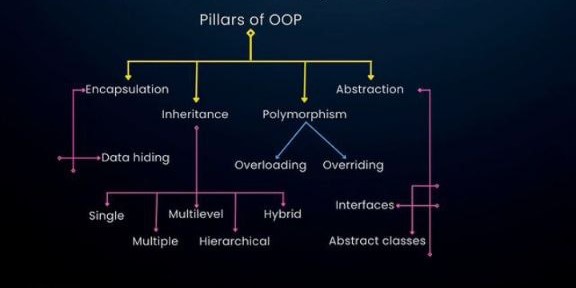
There are four main feature (pillars) of OOP
Why OOP?
OOP is useful because it allows developers to organize code in a more modular and reusable way. It models real-world entities or concepts as "object" with defind characteristics and behaviors. The Key benefits are:
Modularity: Breaking complex problems into smaller, manageable parts (objects).
Reusability: Objects can be reused in different parts of the code or other projects.
Clear Code: Structuring code in an organized way, making it easier to understand and maintain.
Real-World Modeling: Mimicking how we interact with objects in the real world.
What is Encapsulation?
Encapsulation in OOP means bundling data and methods within an object and hidind the internal details. It protects data from unauthorized access and ensures controlled interaction through a defined interface. This promotes code maintainability, security, and flexibility.
What is Abstraction?
Abstraction in OOP simplifies complex objects by focusing only on essential features and hiding unnecessary details. it allow creating abstract classes or interfaces to define common characteristics and promote code reuse. Abstraction help model real-world entities more intuitively and enables easier code maintenance and flexibility.
What is the difference between Abstraction and Encapsulation?
Encapsulation
Abstraction
Bundles data and methods within an objects.
Simplifies complex entities into essential features.
Purpose: Hides internal implementation detalis, exposes a well-defined interface.
Purpose: Provides a clear and high-level view without exposing complexity.
Focus: Data protection, controlled access.
Focus: Hiding irrelevant details, promoting code reuse.
Mechanism: Access modifiers, getter/setter methods.
Mechanism: Abstract classes, interfaces.
Main Benefits: Security, maintainability.
Main Benefits: Code reuse, clearer representation of functionality.
Example: A class with private properties and public method.
Example: An abstract class defining common methods for subclasses.
What is Polymorphism?
Polymorphism inOOP allows different classes to share a common interface. it means objects of these classes can be treated interchangeably through the common interface.
This flexibility enhances code reusability and promotes a more flexible and generic design.
What is Inheritance? What is the purpose?
The idea of inheritance is simple, a class is based an another class and uses data and implementation of the other class.
The purpose of inheritance is Code Reuse
What is the diamond problem in inheritance?
The diamond problem occurs in some programming languages with multiple inheritance when a class inherits from two or more classes that share a common ancestor.
This creates ambiguity and conflicts in the subclass due to duplicated features, making it challenging to determine which version of the inherited feature to use.
To address this issue, some languages use techniques like virtual inheritance or avoid multiple inheritance altogether.
What is Static Binding and Dynamic Binding?
Static Binding: Occurs at compile-time, the method call is resolved based on the declared type of the variable/reference.
Dynamic Binding: Occurs at runtime, the method call is resolved based on the actual type of the object. Allows for polymorphism and greater flexibility.
What is the meaning of "IS-A" and "HAS-A" relationship?
IS-A" Relationship:
Represents inheritance or a class-subclass relationship in OOP.
It signifies that an object of a subclass is a specialized version of its superclass.
Example: A "Car" IS-A "Vehicle" because a car is a specific type of vehicle.
"HAS-A" Relationship:
Represents composition or an object containing another object.
it signifies that a class has a member that is of another class type.
Example: A "CAR" HAS-A "Engine" because a car contains an engine as one of its components.


